
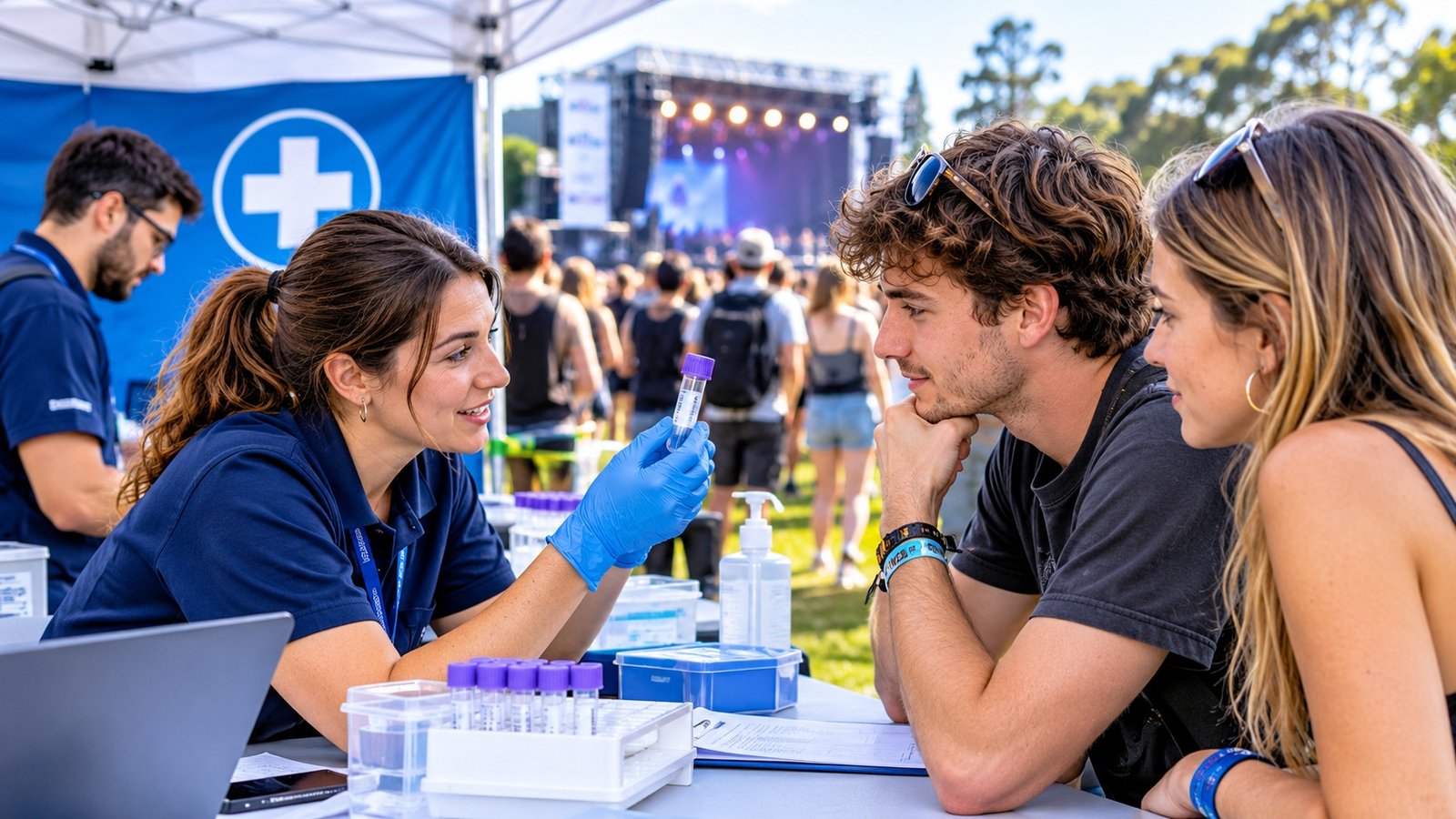
After years of heated debate, drug checking at music festivals is no longer a trial in New South Wales. On 2 September 2026, the NSW Government announced a $4.3 million commitment to continue drug checking at selected festivals from October, covering up to 15 events each year. The decision followed a 12-month trial and an independent evaluation led by the University of Sydney.
Announcements like this tend to be reported in headlines, so it is worth slowing down and looking at what the evaluation actually measured. The numbers tell a more careful story than either side of the pill testing argument usually admits. They also say something about what happens after the festival is over, because a test result is a single moment, while the habits that bring someone to a testing tent can stretch on for years. For some people that later chapter means a GP appointment or a local counselling service. Others eventually need residential care, sometimes as far afield as luxury substance abuse treatment in Malibu. The trial data cannot say who will end up needing that kind of help, but it does show how many people were willing to change their plans on the day.
How the Service Worked on the Ground
According to the University of Sydney evaluation report published by NSW Health, the trial ran from March 2025 to February 2026 across 12 NSW music festivals. The NSW Government’s release explains that it was free and anonymous. Attendees could voluntarily bring a small sample to qualified health staff, and chemists from NSW Health Pathology’s Forensic and Analytical Science Service analysed it on site for purity, potency and adulterants. Peer workers from NUAA then explained the results, and amnesty bins were available for anyone who decided to get rid of their drugs.
That last step matters. The service was not just a laboratory in a tent. It was a conversation with a trained person at the exact point when someone was about to make a decision.
The Figures Behind the Decision
The University of Sydney’s final report, published by NSW Health, contains the detail that the ministerial release only summarises. Several findings stand out:
- Scale: The report records 1,846 service users across 1,010 visits, with 1,475 samples analysed.
- Unexpected results: 8.1 per cent of samples contained an unexpected substance, either alone or alongside the drug the person expected.
- What turned up: Unexpected substances included ketamine analogues, synthetic cathinones, heroin and 1,4-butanediol, and the report called heroin found in a sample expected to be cocaine “a significant finding”.
- Changed plans: Among people whose sample contained only an unexpected substance, 30.0 per cent said they would discard it and 37.5 per cent said they would use less.
- Dose surprises: MDMA tablets and capsules were high dose (over 150 mg free base) in 4.4 per cent of cases, against a median of 87.7 mg.
- First contact: 68.5 per cent of those who answered the question (669 of 976) had never discussed their drug use with a health or harm reduction professional.
Taken together, these figures suggest that most samples were what people thought they were. The value of the service lay in the minority that were not, and in the large share of people who were speaking to a health worker about drugs for the very first time.
Hospital Presentations: Read the Fine Print
The finding that attracted the most attention concerned hospitals. The evaluation compared the trial festivals with historical data from the same festivals from the previous two years where available, which were the 2023 and 2024 editions. Its at-a-glance summary reports drug-related hospital presentations of 3.6 per festival day in the comparison period against 2.3 during the trial, and ICU admissions of 0.9 per festival day against 0.6.
The wording around those numbers is careful. The NSW Government describes the service as “associated with” a reduction in urgent drug-related hospital presentations and ICU admissions, rather than proven to have caused it. Man of Many, reporting on the decision, also noted that the research does not claim pill testing alone caused the drop. The report itself says deaths could not be compared because of outstanding coronial investigations.
What the Minister Was Careful to Say
Health Minister Ryan Park framed the decision cautiously. “Let me be clear, no level of illicit drug use is safe and drug checking services are not a silver bullet,” he said in the government’s release, before adding that drug checking “can reduce harms associated with drug use, and it ultimately saves lives.”
What Festivals Do Not Show
One limitation sits outside the evaluation entirely. Festivals are a small part of the picture. Dr Will Tregoning, chief executive of the harm reduction organisation Unharm, told Man of Many that “festivals cover only a really narrow slice of drug use.” Other jurisdictions have gone further. Man of Many reported that Canberra’s CanTEST has operated as a fixed, year-round service since 2022, and that Victoria’s permanent Fitzroy site tested more than 5,000 samples from more than 3,000 people in its first year.
The same report noted that the 2024 NSW Drug Summit recommended using the festival evaluation to inform other models, including fixed sites, and that the government formally supported this without yet committing to build one.
After the Gates Close
The 68.5 per cent figure may be the most useful number in the whole report for anyone thinking beyond a single weekend. It means that, for most of those who answered, the testing tent was their first conversation with a professional about drugs. For many, that conversation will simply make one night safer. For others, it might be the first moment they hear their own habits described out loud.
If festival use has started spilling into weekdays, or a test result was a wake-up call rather than a relief, a GP is a sensible first stop. They can talk through options without judgement and point towards local services or more structured treatment if it is needed.
Frequently Asked Questions (FAQs)
1. How many NSW festivals will offer drug checking from now on?
The NSW Government says up to 15 music festivals a year will be selected after consultation with the festival industry and harm reduction organisations, taking into account each event’s type, size and location.
2. Did the trial prove pill testing reduces hospital admissions?
Not on its own. The evaluation found the service was associated with fewer drug-related hospital presentations and ICU admissions compared with earlier years of the same festivals, but that is an association rather than proof of cause, and deaths could not be compared because coronial investigations were still open.
3. Who analyses the samples and explains the results?
According to the NSW Government, chemists from NSW Health Pathology’s Forensic and Analytical Science Service analyse samples on site, and peer workers from NUAA explain what the results mean to the person who brought the sample.
 EchoLinkers
 Backlinks Hub