
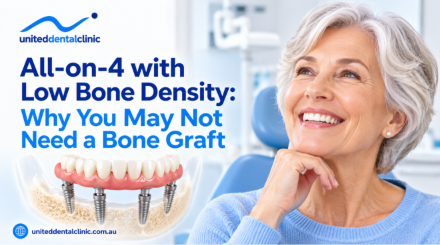
If you have been told you lack the bone for dental implants, there may be good news. All-on-4 is designed to work with low bone density, and most patients avoid a bone graft entirely.
The secret is in how the implants are placed. They are angled to reach the denser bone you still have. If a graft has put you off treatment, a family dentist in Narrabeen can tell you whether All-on-4 suits your case.
This guide further explains how All-on-4 works with low bone.
Why Do Some People Lack Enough Bone?
When you lose a tooth, the bone beneath it slowly shrinks. The longer the tooth has been missing, the more bone is lost over time.
This is why long-term denture wearers often develop a sunken look around the mouth. The bone that once held their teeth has gradually worn away. For traditional implants, this is a real problem. They need a certain amount of bone to anchor into, so not enough bone for dental implants has long been a common barrier to treatment.
In the past, the only fix was a bone graft to rebuild the missing bone first. All-on-4 offers a different path.
How Does All-on-4 Work With Low Bone?
All-on-4 uses four implants, and the clever part is where they go. The two front implants are placed straight, while the two back implants are angled.
Those back implants are tilted at up to 45 degrees. This angle lets them reach the denser bone at the front of the jaw, which holds its density far better than the back. It also lets them avoid the sinus cavities and the areas where bone has worn away. This is why All-on-4 low bone density cases so often succeed without a graft.
The design was created for exactly this situation. By working with the bone you have, rather than demanding bone you have lost, All-on-4 opens treatment to people who were once turned away.
Why Does This Avoid a Bone Graft?
A bone graft rebuilds bone where it is missing. All-on-4 sidesteps the need by anchoring into bone that is already there.
Here is why the angled placement makes the difference:
- It reaches the dense bone at the front of the jaw
- It avoids the thin, resorbed bone at the back
- It steers clear of the sinus cavities
- It spreads the load across the strongest available bone
Because of this, dental implants without bone graft procedures are possible for most patients with moderate bone loss. Skipping the graft also saves a great deal of time, since a graft adds three to nine months of healing before implants can even be placed. With All-on-4, you often avoid that wait entirely.
Can You Get Implants With Existing Bone Loss?
Yes, in most cases. This is the whole reason All-on-4 was developed.
The technique suits people who have some bone loss but still have healthy bone in the front of the jaw. For these patients, dental implants with bone loss are very achievable. The angled implants find the stable bone and anchor firmly into it. Many people who were told years ago that implants were impossible turn out to be strong candidates for All-on-4.
A scan confirms this. Your dentist uses a 3D CBCT scan to map your bone height, width, and density. This shows exactly where the solid bone is, so the implants can be planned around it.
Is It Right for Everyone?
All-on-4 helps most low-bone patients, but it has limits. It is important to be honest about them.
For moderate bone loss, All-on-4 usually works well without a graft. For very severe bone loss, however, there may not be enough solid bone even for angled implants. In those cases, your dentist may still recommend some grafting, or an alternative such as zygomatic implants that anchor into the cheekbone. A thorough assessment is the only way to know which applies to you.
This is why professional planning matters so much. Choosing full-arch dental implants Sydney starts with a proper scan and an honest conversation about your bone.
What Are the Benefits of Skipping the Graft?
Avoiding a graft brings real advantages beyond convenience. For many patients, it makes treatment possible where it was not before.
The main benefits are:
- A faster path to fixed teeth, without months of graft healing
- A less invasive overall procedure
- Lower cost, since grafting is an added expense
- Fixed teeth often fitted on the same day as surgery
For anyone facing full-arch implant low-bone challenges, these benefits are significant. A treatment that once seemed out of reach becomes straightforward and quick.
Find Out If All-on-4 Suits You
Low bone density no longer rules out a fixed, full-arch smile. All-on-4 works with the bone you have, which means most patients skip the graft and the long wait that comes with it. The design is proven, efficient, and genuinely life-changing for people with significant tooth loss.
If a bone graft has held you back, it is worth getting a second opinion. Book a consultation with an All-On-4 Treatment Narrabeen team at United Dental Clinic, and find out whether you can skip the graft and get your smile back sooner.
Frequently Asked Questions
Can I get All-on-4 if I was told I need a bone graft?
Often, yes. All-on-4 uses angled implants to reach denser bone, so many patients told they need a graft turn out to be suitable candidates. A scan confirms it.
How does the dentist check if I have enough bone?
With a 3D CBCT scan. This maps your bone height, width, and density, showing exactly where the solid bone is so the implants can be planned around it.
What if I have severe bone loss?
Very advanced bone loss may still need some grafting, or an alternative like zygomatic implants. Your dentist will assess your scan and recommend the best option.
Is All-on-4 without a graft as strong as with one?
Yes. The angled implants anchor into dense, stable bone, giving a strong foundation. Studies show high success rates for this graftless approach.
 Wild Rise
 Backlinks Hub