
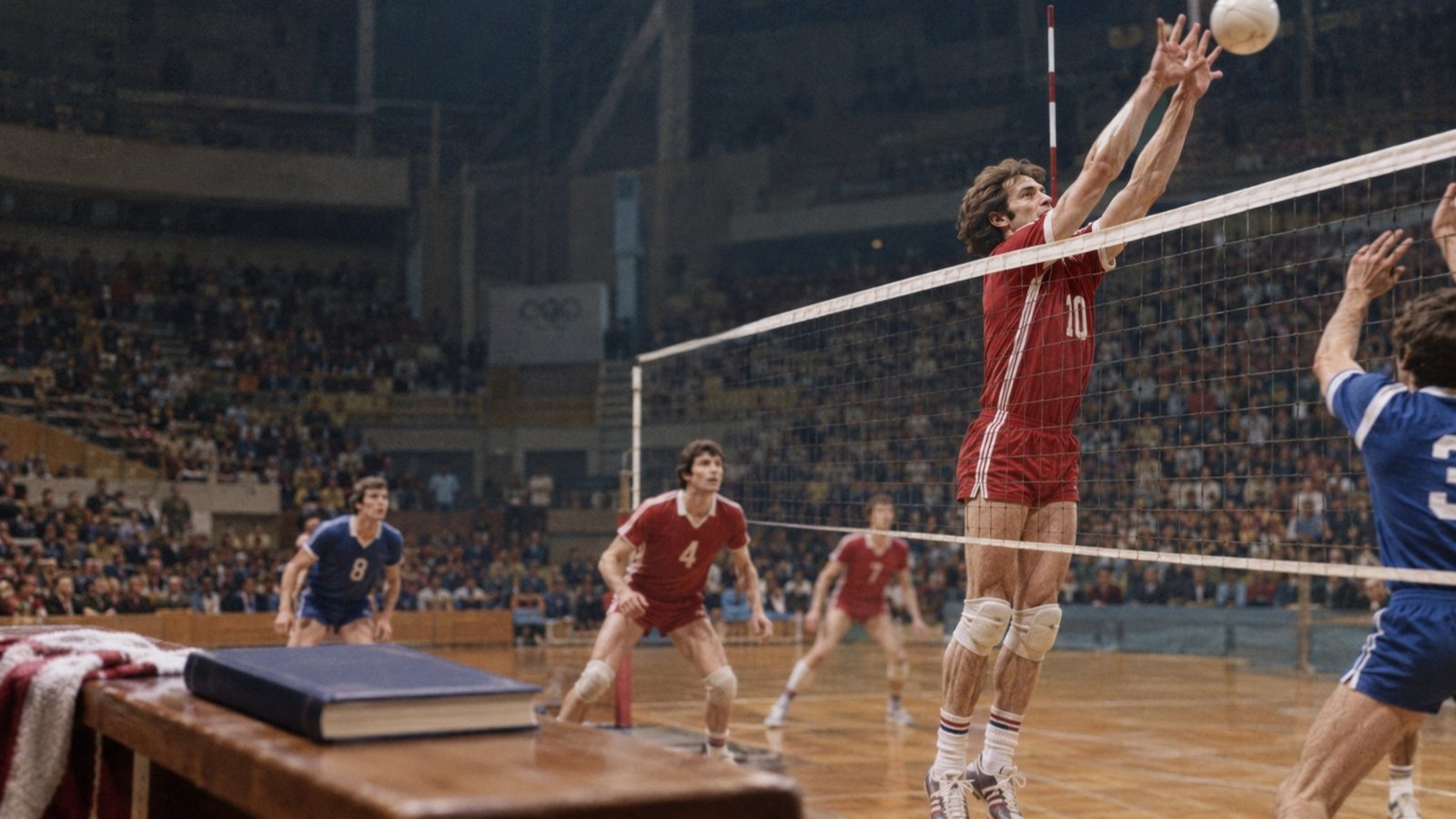
Olympic stories are often remembered through medals, records, and historic victories. But behind every medal is an athlete whose career includes years of training, competition, setbacks, teammates, coaches, and personal experiences that may never appear in an official results table.
The Flying Elephant Memoirs of an Olympic Champion Kindle Edition gives readers an opportunity to explore that personal side through the story of Alexander Savin, a Soviet volleyball player who competed at two Olympic Games.
Savin won an Olympic silver medal at the 1976 Montreal Games before becoming an Olympic champion at the 1980 Moscow Olympics. His career also included major international success with the Soviet national volleyball team, making his experiences relevant not only to volleyball fans but also to readers interested in Olympic history and Soviet-era sport. The International Volleyball Hall of Fame recognizes Savin as a 2010 inductee.
The English Kindle edition brings this sporting story to a wider audience. Available information about the edition describes a substantial collection of photographs alongside Savin’s memories, giving readers both a personal account and a visual connection to the volleyball world in which he competed.
What Is The Flying Elephant: Memoirs of an Olympic Champion?
The Flying Elephant: Memoirs of an Olympic Champion is a sports memoir associated with Alexander Savin and his career in elite Soviet volleyball. Rather than being a conventional biography written by an outside researcher, the book presents the experiences of an athlete who personally lived through the competitions, training environment, relationships, and sporting culture described in the memoir.
That distinction is important for readers searching for the book because its appeal goes beyond a simple list of Olympic achievements. Savin’s career stretched across several major international competitions, including the 1976 Montreal and 1980 Moscow Olympic Games. His Olympic journey alone contains a notable progression: silver in Montreal followed by gold four years later in Moscow.
The English edition is particularly interesting for readers who want access to this story without reading the original Russian material. Reports about the English project describe the involvement of Savin’s family and translators in bringing the memoir to English-speaking readers.
The Flying Elephant Kindle Edition at a Glance
For readers looking specifically for the Kindle version, available listing information provides several useful details about the edition.
| Detail | Information |
| Book title | The Flying Elephant: Memoirs of an Olympic Champion |
| Author | Alexander Savin |
| Format | Kindle Edition |
| Language | English |
| Reported publication date | October 26, 2025 |
| Reported print length | 514 pages |
| Reported photographs | More than 240 |
| Amazon identifier | B0FXVDWW16 |
| Sport | Volleyball |
| Olympic Games in Savin’s career | Montreal 1976 and Moscow 1980 |
The Kindle listing details reported by current sources include a 514-page print length and more than 240 photographs. Edition availability and Kindle features can vary by Amazon marketplace, so readers should check their local listing for the latest purchasing information.
Who Is Alexander Savin?
Alexander Savin, also listed in some sporting records as Aleksandr Borisovich Savin, was a Soviet volleyball player born on July 1, 1957, in Taganrog. Olympedia records him at 200 cm and identifies his club affiliation with CSKA Moskva.
Savin competed for the Soviet Union during one of the country’s highly successful periods in international men’s volleyball. His Olympic career included two appearances and two medals. At Montreal in 1976, he helped the Soviet team reach the final, where the USSR lost to Poland and received silver. Four years later, at Moscow in 1980, the Soviet Union defeated Bulgaria in the final and Savin became an Olympic champion.
His achievements were not limited to the Olympics. Records cited by the International Volleyball Hall of Fame and Olympedia place him within a successful generation of Soviet volleyball players who won major European and world competitions during the 1970s and 1980s.
This background helps explain why a memoir from Savin can be interesting even for readers who already know the results of his Olympic competitions. Official records can tell us when an athlete competed and what medal they won, while a memoir can provide a more personal perspective on the sporting environment behind those results.
Alexander Savin’s Olympic Journey
The Olympic part of Savin’s career provides one of the clearest ways to understand the significance of his memoir.
At the 1976 Montreal Olympics, Savin competed for the Soviet Union in men’s volleyball. The Soviet team progressed through the tournament and reached the final against Poland. Poland eventually won the match 3–2, giving Savin and the USSR the silver medal. Records indicate that Savin appeared in all five Soviet matches during the competition.
Four years later, the circumstances were different. The 1980 Moscow Olympics were held in the Soviet Union, and Savin returned as part of the Soviet men’s volleyball team. The USSR defeated Bulgaria 3–1 in the final to win the Olympic gold medal. Savin played in all six Soviet matches during that Olympic tournament, according to the cited historical records.
His Olympic record can therefore be summarized simply:
- 1976 Montreal: Olympic silver
- 1980 Moscow: Olympic gold
The change from silver in Montreal to gold in Moscow gives Savin’s career a natural sporting narrative, but it is only one part of the larger story explored through his memoir and career history.
Why Alexander Savin’s Story Matters to Volleyball History
Savin’s career took place during an important period in international volleyball. The Soviet men’s team was a major force in European and world competition, and Savin spent years competing alongside and against some of the strongest players of his generation.
His connection with CSKA Moscow is also relevant because the club was closely associated with Soviet elite sport. For readers researching Soviet volleyball, Savin’s experiences can therefore provide a personal entry point into a much larger sporting history.
This is one reason The Flying Elephant can be viewed as more than an Olympic medal story. It connects an individual athlete’s memories with the development of international volleyball during a particular historical period.
What Can Readers Expect From The Memoir?
Readers searching for the flying elephant memoirs of an olympic champion kindle edition are likely looking for more than basic information about Savin’s medal record. The value of a memoir lies in the experiences behind those achievements.
Available descriptions of the English edition point toward memories of Soviet volleyball, teammates, coaches, competitions, training environments, and the people who shaped Savin’s sporting life. The edition is also described as containing more than 240 photographs drawn from private collections and archival material.
That combination of personal memories and historical photographs gives the book a broader appeal. A reader can approach it as an athlete memoir, an Olympic story, a volleyball-history resource, or a window into the sporting culture surrounding Soviet international competition.
The most useful way to approach the book, however, is to separate documented facts from interpretation. Savin’s Olympic medals and Hall of Fame status are independently documented, while individual descriptions of memories, relationships, and the meaning behind the book’s title belong to the memoir and its associated publishing material.
The Story Behind the English Kindle Edition
For readers searching for the flying elephant memoirs of an olympic champion kindle edition, one of the most interesting parts of the book is the journey that brought Alexander Savin’s story to English-speaking audiences.
The memoir originally existed in Russian, reflecting Savin’s own experiences in Soviet volleyball. The later English edition made those memories accessible to a much wider international readership, particularly people interested in Olympic history, volleyball, and first-person accounts of Soviet-era sport.
The English project also involved people close to Savin and a group of translators and editors. Available edition information identifies Andrei Savine as an editor and translator, with additional contributions from Julia Savine, Alfredo Cabero, and Peter Murphy. The contributors should not be confused with the author of the memoir itself: Alexander Savin remains the central author and subject of the work.
This distinction is useful because the English edition is not simply a newly written biography about Savin. It is an English presentation of a memoir centered on his own sporting experiences.
More Than 240 Photographs Add a Visual History
One of the notable features associated with the English edition is its large collection of photographs. Current edition descriptions report more than 240 photographs, making the book considerably more visual than a typical sports memoir.
For a story connected to Soviet volleyball, photographs can provide context that written descriptions cannot always capture.
They can help readers see the athletes, teams, competitions, venues, uniforms, ceremonies, and sporting environments associated with Savin’s career. They also give the memoir a historical dimension because many of the events described belong to an earlier period of international sport.
This makes the photographic material useful for more than decoration. Readers interested in volleyball history can approach the images as part of the record of a particular generation of athletes.
The extensive visual material also helps explain why the reported Kindle file size is relatively large compared with a simple text-based ebook.
Why the Title “The Flying Elephant” Stands Out
The title The Flying Elephant immediately creates curiosity.
An elephant normally suggests size and strength, while flying suggests lightness, movement, and agility. In Savin’s case, the nickname has been associated with the contrast between his physical stature and his ability to move and jump effectively as a volleyball player.
That contrast fits the demands of volleyball particularly well.
A middle blocker needs height and reach near the net, but size alone does not make an effective player. Quick movement, timing, coordination, jumping ability, positioning, and reactions are also important.
The nickname therefore provides an interesting way to think about Savin’s playing identity. It connects physical presence with athletic movement rather than treating the two qualities as opposites.
Readers should still distinguish documented explanations of the nickname from later interpretations. The safest way to understand the title is within the context of Savin’s volleyball career and the descriptions associated with the memoir.
Alexander Savin and the Golden Era of Soviet Volleyball
Savin’s story is also connected to a much larger chapter of international volleyball.
During his career, the Soviet Union was a major force in men’s volleyball. Savin competed at the highest international level during a period when Soviet teams regularly appeared in major tournaments and Olympic competition.
His club career with CSKA Moscow is an important part of that background. CSKA was closely connected with the Soviet elite sports system, and competing for the club placed Savin within a highly competitive sporting environment.
This historical setting gives the memoir another layer. A reader is not only following one player’s journey but also encountering the sporting culture surrounding international volleyball during the Cold War era.
For modern readers who know volleyball mainly through contemporary professional leagues, the memoir can therefore provide a different perspective on how elite competition functioned several decades ago.
Life Inside Elite Soviet Volleyball
Elite sport can look very different from the outside.
Fans usually see the final match, the scoreboard, and the medal ceremony. An athlete experiences the much longer process leading to those moments.
Training sessions, travel, preparation, competition schedules, team relationships, coaching, physical conditioning, and the pressure of representing a national team all become part of everyday life.
That is where a first-person sports memoir can provide information that competition statistics cannot.
Savin’s experiences place readers closer to the people and circumstances behind his Olympic results. Instead of viewing an Olympic medal as an isolated achievement, the memoir provides a way to consider the years of sporting activity surrounding it.
This is particularly relevant to readers interested in how athletes develop over long careers rather than only focusing on a single championship.
From Montreal Silver to Moscow Gold
One of the clearest threads in Savin’s Olympic story is the contrast between his two Games.
At the 1976 Montreal Olympics, the Soviet men’s volleyball team reached the final but lost to Poland, finishing with the silver medal. Savin therefore experienced Olympic success without winning the tournament.
Four years later, he returned for the 1980 Moscow Olympics. This time the Soviet Union reached the final and defeated Bulgaria, giving Savin an Olympic gold medal.
The two results provide useful context for understanding his career.
The 1976 Games represent a major achievement, but they also preceded the championship that came four years later. The 1980 Games brought the Olympic title that would become one of the defining accomplishments associated with Savin’s career.
For readers approaching the memoir, this progression gives the Olympic portion of the story a clear chronological framework.
Why the Memoir Is Different From a Standard Athlete Biography
A standard athlete biography may be written by a journalist, historian, researcher, or another writer who reconstructs a person’s life from interviews and available records.
A memoir has a different starting point.
The central perspective comes from the person who experienced the events.
That does not mean every memory should automatically be treated as an independently verified historical fact. Personal memories can contain individual perspectives and interpretations. However, they can preserve details that are difficult to find in official competition records.
This makes The Flying Elephant interesting from two complementary viewpoints.
First, it is the story of Alexander Savin’s life in elite volleyball.
Second, it provides a personal perspective on a period of sporting history that may otherwise be understood mainly through statistics, results, and archived competition records.
The Book as a Record of Volleyball History
The historical value of a sports memoir does not necessarily come from replacing official records. Instead, it can add another layer to them.
Olympic databases can tell readers where a competition took place, which teams participated, and which country won a medal. A memoir can add memories of the people, preparation, relationships, atmosphere, and experiences surrounding those events.
The photographs serve a similar purpose.
Together, personal memories and visual material can help preserve details from an earlier sporting era. This is particularly relevant for readers studying Soviet volleyball or the development of international men’s volleyball during the second half of the twentieth century.
For this reason, The Flying Elephant Memoirs of an Olympic Champion Kindle Edition can appeal beyond readers simply looking for an inspirational sports story.
What Makes the Kindle Edition Useful for Modern Readers?
The digital edition changes how contemporary readers can access Savin’s story.
Instead of needing to locate an older Russian publication or a physical copy, English-speaking readers can access the translated memoir through the Kindle format where the edition is available.
The digital format is also convenient for readers who prefer to keep books on a phone, tablet, computer, or Kindle device.
Because this particular edition is reported to contain extensive photographic material, readers interested in the visual side of the book should pay attention to the Kindle app or device they use. Image presentation can vary depending on the device, application, and display settings.
The exact price, regional availability, and Kindle purchasing options can also change, so those details are best checked on the current retailer listing rather than relying on an older article.
Current online descriptions of the English edition report several useful specifications.
Title: The Flying Elephant: Memoirs of an Olympic Champion
Author: Alexander Savin
Format: Kindle Edition
Language: English
Reported publication date: October 26, 2025
Reported print length: 514 pages
Reported photographs: More than 240
Reported file size: Approximately 68.8 MB
Reported Amazon identifier: B0FXVDWW16
These details describe the currently reported English Kindle edition, but digital-book metadata can change. Readers should verify the live Amazon listing for their particular country before purchasing.
Who May Find This Memoir Interesting?
The book can attract several types of readers.
Volleyball fans may be interested in Savin’s experience at the highest level of international competition.
Olympic history readers can use the memoir as a personal perspective on the 1976 and 1980 Games.
Sports historians may appreciate the connection to Soviet-era volleyball and the extensive photographic material.
Athletes and coaches may be interested in the experiences of a player who competed at Olympic level.
Readers of memoirs can approach the book as a first-person story about a long sporting career rather than simply as a record of medals.
The common thread is an interest in the experiences behind elite athletic achievement.
The Flying Elephant Is More Than an Olympic Medal Story
It would be easy to reduce Alexander Savin’s career to two Olympic results: silver in 1976 and gold in 1980.
Those achievements are important, but they do not describe an entire athletic life.
A career at international level involves years before and after the Olympic podium. It includes teammates, coaches, clubs, tournaments, preparation, travel, competition, changing circumstances, and the transition away from active competition.
That broader perspective is what gives a memoir its value.
For someone searching for the flying elephant memoirs of an olympic champion kindle edition, the most useful way to approach the book is therefore not simply as an Olympic victory story. It is a personal account connected to a particular athlete, a particular generation of volleyball, and a particular period in international sporting history.
And that combination is what gives The Flying Elephant its distinctive place among sports memoirs.
What Readers Can Learn From Alexander Savin’s Olympic Journey
The value of a sports memoir is not limited to the final result of a competition. Alexander Savin’s career provides an opportunity to look at what exists behind an Olympic medal: preparation, competition, teamwork, and years spent developing as an elite athlete.
His Olympic record is particularly interesting because it includes both a silver medal and a gold medal. The experience of competing for an Olympic title and later returning to win one gives readers a broader perspective than a story built around a single victory.
The memoir can therefore be read as a sporting journey rather than simply a celebration of an Olympic championship.
The Importance of Long-Term Preparation
Olympic success normally represents the result of years of preparation rather than a single season.
For volleyball players, that preparation includes technical skills, physical conditioning, tactical understanding, teamwork, and experience competing against strong opponents.
Savin’s career demonstrates this long-term nature of elite sport. His Olympic appearances came within a much larger career in Soviet volleyball, meaning the medals were milestones in an extended sporting journey.
Teamwork Is Central to Volleyball
Unlike individual Olympic events, volleyball depends heavily on coordination between teammates.
A successful team needs players to communicate, understand their roles, react quickly, and make decisions together during constantly changing rallies.
Savin competed as part of Soviet teams rather than pursuing Olympic success alone. His story therefore provides an opportunity to understand elite achievement from a team-sport perspective.
This is one reason the memoir may interest readers who want to learn about the people and relationships behind successful volleyball teams.
Competition Can Include Both Victory and Defeat
One useful aspect of Savin’s Olympic record is that it includes different outcomes.
The Soviet team won silver in Montreal in 1976 and gold in Moscow in 1980. Looking at both competitions provides a more complete picture of elite sport than focusing exclusively on the eventual championship.
For readers, this distinction matters because athletic careers are rarely defined by victories alone. International competitors experience wins, losses, adjustments, and changing circumstances throughout their careers.
The Historical Value of a Soviet Volleyball Memoir
The Flying Elephant can also be approached as a historical sports book.
Savin competed during the Soviet era, when international sport was closely connected with the broader political and cultural environment of the Cold War. Athletes representing the Soviet Union competed against teams from many countries at major international events, including the Olympic Games.
A personal memoir cannot by itself provide a complete history of that period. However, it can preserve an athlete’s perspective on what it was like to participate in international sport during those years.
The photographs associated with the edition add another layer to that historical record.
For researchers and volleyball enthusiasts, visual material from competitions and sporting environments can make an older period easier to understand and place in context.
The Flying Elephant as a Sports-History Resource
Readers should not necessarily approach the memoir as an academic history of Soviet volleyball.
Its primary identity is a memoir.
That means its greatest value comes from the personal perspective of Alexander Savin and the experiences connected with his career. Readers who want official medal tables, match statistics, or comprehensive tournament records should also consult specialized Olympic and volleyball databases.
Using both types of sources creates a more complete picture.
Official records establish what happened in competitions, while memoirs can provide personal context surrounding those events.
This distinction is particularly important for readers who want accurate information rather than treating every personal recollection as an independently verified historical record.
Memoir vs. Biography: What Is the Difference?
The terms memoir and biography are sometimes used interchangeably, but they describe different approaches to someone’s life.
A biography is generally written by another person who researches and documents the subject’s life.
A memoir focuses more narrowly on the author’s own memories and experiences.
That difference makes The Flying Elephant especially relevant to readers interested in Alexander Savin’s personal perspective. Instead of looking at his career entirely from the outside, the memoir gives the reader access to his experiences through his own account.
At the same time, readers should remember that memoirs represent personal perspectives. They work best alongside reliable historical records when the goal is to establish precise dates, statistics, or competition results.
Is The Flying Elephant Suitable for Non-Volleyball Readers?
You do not necessarily need to be a dedicated volleyball fan to understand the appeal of the book.
The central subject is an athlete’s experience at the highest level of international sport. The Olympic setting provides a recognizable framework, while the memoir format focuses attention on the person behind the achievements.
Readers who enjoy athlete autobiographies, Olympic history, Cold War sports history, or first-person accounts of professional competition may therefore find the book relevant even if volleyball is not their main interest.
However, readers primarily looking for a technical volleyball coaching manual should understand that a memoir serves a different purpose. Its emphasis is on experiences and memories rather than step-by-step training instruction.
Is the Kindle Edition Worth Considering?
Whether the Kindle edition suits a particular reader depends largely on what they want from the book.
For someone specifically interested in Alexander Savin, Soviet volleyball, Olympic history, or sports memoirs, the English digital edition provides convenient access to the story.
The reported collection of more than 240 photographs is another notable feature for readers interested in the visual and historical side of the book.
On the other hand, readers who prefer physical books, collectible sports editions, or printed photographs may prefer a physical format if one is available in their region.
The practical details—including price, availability, and supported Kindle features—can change, so readers should check the current retailer listing before making a purchase.
Frequently Asked Questions About The Flying Elephant Memoirs of an Olympic Champion Kindle Edition
What is The Flying Elephant: Memoirs of an Olympic Champion?
The Flying Elephant: Memoirs of an Olympic Champion is a sports memoir centered on Alexander Savin, the Soviet volleyball player and Olympic champion. The book presents his experiences from a career that included major international and Olympic competition.
Who wrote The Flying Elephant?
The memoir is by Alexander Savin, whose international volleyball career included Olympic appearances for the Soviet Union.
What sport did Alexander Savin compete in?
Alexander Savin was a volleyball player. He competed at international level for the Soviet Union and was associated with CSKA Moscow during his playing career.
Did Alexander Savin win an Olympic gold medal?
Yes. Savin won Olympic silver with the Soviet men’s volleyball team at the 1976 Montreal Olympics and Olympic gold at the 1980 Moscow Olympics.
When was the reported English edition published?
Available online edition information reports October 26, 2025 as the publication date for the English edition. Readers should verify the current retailer listing because digital metadata can change.
How long is the Kindle edition?
Current descriptions report a 514-page print length for the edition. Kindle page counts can display differently depending on font size and reading settings.
Does the book contain photographs?
Yes. Available descriptions of the edition report more than 240 photographs, adding a substantial visual element to the memoir.
Is The Flying Elephant a biography or memoir?
It is presented as a memoir, meaning the book centers on Alexander Savin’s own experiences and recollections rather than being solely an outside biography of his life.
Is the book available in English?
The English edition makes Savin’s memoir accessible to English-speaking readers. The edition is associated with a translation and editorial project involving contributors who helped bring the original material to an English audience.
Who would be interested in this book?
The book may appeal to volleyball fans, Olympic-history readers, sports-memoir enthusiasts, and people interested in Soviet-era international sport. Its photographic material may also interest readers researching the history of volleyball.
What does “The Flying Elephant” refer to?
The title is associated with Savin’s identity as a large volleyball player who was nevertheless capable of the movement and jumping required at the net. The phrase captures the contrast between physical size and athletic mobility.
Can the book be read by someone who does not follow volleyball?
Yes. The memoir is centered on an athlete’s experiences and Olympic career, so readers can approach it as a sports-life story even without extensive knowledge of volleyball.
Final Thoughts on The Flying Elephant Memoirs of an Olympic Champion Kindle Edition
The Flying Elephant Memoirs of an Olympic Champion Kindle Edition offers readers a chance to look beyond the Olympic medal table and explore the career of Alexander Savin from a personal perspective.
Savin’s Olympic journey is already notable: he earned silver at Montreal in 1976 before becoming an Olympic champion at Moscow in 1980. His wider career in Soviet volleyball places those achievements within a much larger story of international competition.
The English edition adds another reason for modern readers to take an interest in the memoir. Alongside Savin’s personal account, the reported collection of more than 240 photographs provides visual material connected with his sporting life and the era in which
 Owner
Owner