
Introduction
Social media has become an important part of how modern brands connect with people, share content, and build an online reputation. This is why terms such as bouncemediagroup.com social stat are attracting attention from people who want to understand social media performance and audience growth. Social statistics can provide useful information about followers, engagement, reach, impressions, clicks, video views, and overall growth.
For a business or digital marketer, these numbers are more than simple figures. They can help show whether content is reaching the right audience and whether people are actually interacting with it. However, social statistics can change regularly, and figures published by different websites may not always match.
This guide explains what bouncemediagroup.com social stat means, which social media metrics matter, how platform statistics can be understood, and why reported figures should be checked carefully. It also explains how businesses can use social data to improve their marketing strategy and avoid common mistakes when reading social media numbers.
What Is Bouncemediagroup.com Social Stat?
The term bouncemediagroup.com social stat generally refers to social media statistics associated with BounceMediaGroup.com and its online presence. In simple words, it is a way of looking at measurable information that shows how a brand performs across social media platforms.
Social statistics can include the number of followers, likes, comments, shares, saves, views, reach, impressions, and engagement. Other useful measurements include click-through rates, website visits from social platforms, follower growth, and conversions. Each metric tells a different part of the story.
For example, a follower count can show the size of an audience, but it does not necessarily show how active that audience is. A page with fewer followers can sometimes receive more meaningful interaction than a much larger page. This is why engagement and audience quality should be considered alongside follower numbers.
It is also important to separate social statistics from general website statistics. Website statistics usually focus on visitors, page views, traffic sources, and conversions on a website. Social statistics focus mainly on activity and performance across social platforms.
Why Are People Searching for Bouncemediagroupcom Social Stat?
People may search for bouncemediagroupcom social stat because they want to learn more about BounceMediaGroup’s online presence and social media performance. Social statistics can offer a quick way to understand how visible a brand is and how its audience interacts with its content.
Marketers may also be interested in platform-by-platform information. Instead of looking only at an overall follower count, they may want to know how a brand performs on Instagram, Facebook, LinkedIn, X, TikTok, or YouTube. Looking at individual platforms can reveal where a brand appears to have stronger visibility or engagement.
Another reason for searching this keyword is the availability of different statistics online. Third-party articles sometimes publish estimated figures for social followers or engagement. Since social numbers can change over time, readers may want to compare these figures and determine whether they are current.
For businesses, social statistics can also serve as a reference point. They can help marketers think about content frequency, audience interaction, and the types of posts that attract attention. However, social numbers should be used as supporting information rather than as the only measure of a company’s success.
BounceMediaGroup.com Social Media Presence
BounceMediaGroup’s social presence can be viewed through several major social media channels, including Instagram, Facebook, LinkedIn, X, TikTok, and YouTube. Each platform has its own audience and content style, so the same type of post may not perform equally well everywhere.
Major Social Platforms
Instagram is particularly suited to visual posts, Reels, Stories, and other short-form content. Facebook can support community interaction, shared content, and longer-form updates. LinkedIn is more focused on professional and business audiences, making it useful for industry insights and business-related posts.
X can support quick updates and conversations, while TikTok and YouTube are strongly connected with video content. YouTube, in particular, provides additional measurements such as watch time and audience retention.
Content and Audience Strategy
A strong social media presence is usually built through consistent and useful content. Educational posts, marketing tips, industry information, videos, promotional material, and community-focused content can all contribute to audience growth.
The important point is that every platform should be viewed according to its purpose. A high number of video views on TikTok means something different from strong professional engagement on LinkedIn. Understanding that difference makes social statistics much more useful.
Bouncemediagroupcom Social Stat: Key Metrics to Understand
A useful analysis of bouncemediagroupcom social stat should look beyond follower numbers. Several metrics work together to explain social media performance.
Followers and Engagement
Followers represent the number of people who have chosen to follow an account. They can indicate potential audience size, but they do not guarantee interaction. Engagement provides a clearer picture of whether people are responding to content through likes, comments, shares, saves, or other actions.
Reach and Impressions
Reach refers to the number of unique users who see content, while impressions represent the total number of times content is displayed. One person can create multiple impressions, so impressions are normally higher than reach.
Growth and Website Traffic
Follower growth shows whether an audience is expanding over time. Looking at monthly or yearly growth can be more useful than checking one day’s follower count.Social statistics can also include website referral traffic. When people click from a social post to a website, that traffic can show whether social activity is contributing to broader business goals.
Video Performance
For video content, views alone do not tell the complete story. Watch time, completion rate, shares and audience retention can provide a better understanding of how people respond to videos.
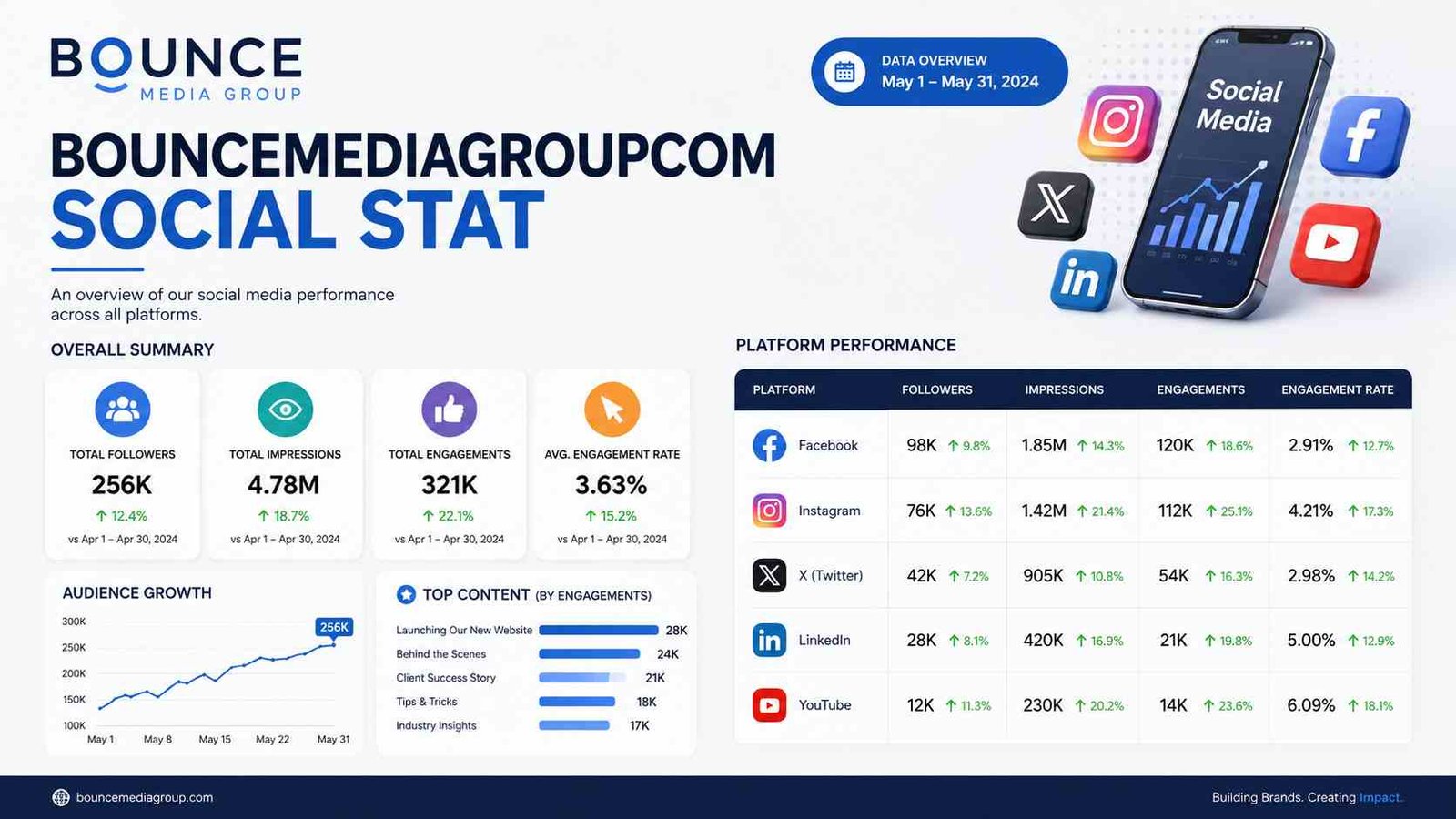
Reported Bouncemediagroupcom Social Stat Figures
Readers searching for bouncemediagroup.com social stat may specifically be looking for numerical figures. However, these numbers should be treated carefully because publicly available sources can report different totals.
| Metric | Reported Status | What It Shows |
| Followers | Varies by source | Potential audience size |
| Engagement rate | Varies by source | Audience interaction |
| Follower growth | Source dependent | Audience expansion |
| Reach | Source dependent | Unique content exposure |
| Impressions | Source dependent | Total content displays |
| Referral traffic | Usually private | Visits generated from social media |
Some online sources have cited combined follower figures of around 240,000, while other sources have reported more than 150,000. Such differences demonstrate why a reader should not automatically treat a third-party figure as an official current number.
The safest approach is to identify the date of the statistic and determine whether it comes from an official social profile, a third-party estimate, or another source. Social audiences can grow or decline, meaning an old number may no longer represent the current situation.
Are Bouncemediagroup.com Social Stats Accurate?
Accuracy is one of the most important issues when researching social statistics. Different websites may show different figures because they collect information at different times or use different methods. A follower count can change every day, while engagement rates can change with every new post.
There is also an important difference between public information and private analytics. Anyone may be able to see a public follower count or visible likes and comments, but detailed information such as private reach, impressions, audience demographics, conversions, and internal website traffic may only be available to the account owner.
For this reason, bouncemediagroup.com social stat figures found on third-party websites should be described as reported or estimated unless they can be confirmed through a reliable first-party source.
How to Verify Social Statistics?
Start by checking the brand’s official social profiles and the date when the number was recorded. Compare information from more than one source, but do not assume that the highest or newest-looking number is automatically correct.It is also useful to check whether a source explains how its figure was calculated. A transparent methodology makes a statistic easier to understand and evaluate.
How to Calculate Social Media Engagement Rate?
Engagement rate is one of the most useful social media measurements because it shows how actively an audience responds to content.A basic formula is:
Engagement Rate = Total Engagements ÷ Reach or Followers × 100
The exact formula can differ depending on the platform and the reporting method being used. Some calculations use followers, while others use reach or impressions.
For example, imagine a post receives 500 total interactions and reaches 10,000 people. Using reach as the denominator, the engagement rate would be 5%. This means that the total interactions were equal to 5% of the people reached.
The number becomes more meaningful when compared over time. If similar posts regularly generate higher engagement, that may suggest the content is becoming more relevant to its audience. However, one unusually successful post should not be used to judge an entire social media strategy.
How Bouncemediagroup.com Social Stat Can Help Marketers?
Social statistics can help marketers make better decisions about content and audience strategy. Instead of guessing what people like, marketers can examine actual performance data and identify patterns.
For example, if short videos consistently receive more engagement than standard posts, a brand may decide to produce more video content. If LinkedIn generates stronger business traffic than another platform, the marketing team may choose to invest more effort there.
Social data can also help with campaign measurement. A marketer can compare performance before, during, and after a campaign to understand whether the campaign increased reach, engagement, traffic, or conversions.
The most useful approach is to connect social metrics with real business goals. Followers and likes can show audience activity, but website visits, leads, sales, or other conversions can show whether social media is contributing to business results.
What Content Can Improve Social Media Performance?
Content quality has a major influence on social media performance. Short-form videos such as Reels, TikTok videos, and YouTube Shorts can attract attention quickly because they are easy to consume and share.
Educational content is another useful format. Tutorials, guides, practical tips, and industry insights can give audiences a reason to follow and return to a page. Instead of focusing only on promotion, helpful content can build trust over time.Interactive content can also encourage participation. Polls, questions, quizzes, and stories give followers simple ways to respond. These interactions can provide useful audience feedback while making a social account feel more active.
User-focused content, including case studies, testimonials, success stories, and community posts, can add another layer of credibility. The best content strategy is usually not based on one format. It combines different types of content and then uses performance data to identify what works best.
Bouncemediagroupcom Social Stat Trends in 2026
Social media continues to change, and the way brands measure performance is changing with it. Short-form video remains important, while social platforms are increasingly used for search and discovery rather than only for social interaction.
Another important trend is the move away from simple vanity metrics. A large follower count can look impressive, but marketers increasingly want to know whether those followers engage, visit websites, become customers, or take meaningful actions.
Personalized content, creator partnerships, cross-platform strategies, and better conversion tracking are also becoming more important. At the same time, businesses need to pay closer attention to first-party data because public social numbers cannot reveal every part of audience behavior.
For anyone researching bouncemediagroup.com social stat, these trends provide useful context. A social account should not be judged only by how many people follow it. Its content quality, engagement, audience growth, traffic, and business outcomes should also be considered.
Common Mistakes When Reading Social Stats
One common mistake is focusing entirely on followers. A large audience does not automatically mean strong performance. Engagement, reach, traffic, and conversions can provide a more complete picture.
Another mistake is comparing statistics from different platforms as if they were identical. Instagram engagement, LinkedIn interaction, TikTok views, and YouTube watch time measure different types of activity.
Using old statistics is another problem. Social numbers can change quickly, so every figure should have a clear date or timeframe. Readers should also avoid treating estimated third-party figures as confirmed facts.
Finally, looking at one successful post can create a misleading impression. Long-term trends are more useful because they show whether performance is consistently improving or declining.
Bouncemediagroupcom Social Stat vs. Other Social Media Metrics
| Metric | Main Purpose | Why It Matters |
| Followers | Audience size | Shows potential audience |
| Reach | Unique exposure | Shows how many users saw content |
| Impressions | Total exposure | Shows how often content appeared |
| Engagement | Interaction | Shows audience response |
| CTR | Traffic | Measures link clicks |
| Conversion rate | Business results | Measures completed actions |
| Growth rate | Expansion | Shows audience development |
These metrics should work together rather than being viewed separately. Followers can indicate audience size, while engagement can reveal audience interest. Reach and impressions show exposure, while clicks and conversions connect social activity to measurable actions.
Frequently Asked Questions
1. What does bouncemediagroupcom social stat mean?
It generally refers to social media statistics connected with BounceMediaGroup.com, including information such as followers, engagement, reach, impressions, growth, and other performance measurements.
2. Are the reported BounceMediaGroup social numbers official?
Not necessarily. Figures published by third-party websites may be estimates or may have been collected at different times. Current numbers should be checked against reliable first-party sources whenever possible.
3. Why can two websites show different social statistics?
Social numbers change continuously, and different websites may use different collection dates, platforms or calculation methods. One source may also include more social platforms than another.
4. Which social metric should marketers focus on first?
There is no single best metric for every goal. Engagement may be important for audience interaction, while clicks and conversions may be more important when the goal is generating website traffic or business results.
5. How often should social media statistics be reviewed?
Businesses can review important metrics regularly and compare them over longer periods. Monthly comparisons can help identify meaningful changes without giving too much importance to normal day-to-day fluctuations.
Conclusion
Bouncemediagroup.com social stat is best understood as a search term related to social media performance and the measurable activity of BounceMediaGroup across social platforms. Followers, engagement, reach, impressions, growth, video performance, and website traffic can all provide useful information.However, social statistics should always be viewed in context. Public figures may change quickly, and third-party websites can report different numbers. The most reliable approach is to check the source, date and methodology before accepting a figure as accurate.
For marketers, the real value of social statistics is not simply seeing a large number. It is understanding what those numbers say about audience interest, content performance, growth, and business results. When used carefully, social data can support smarter and more effective digital marketing decisions.